Service Level Agreement (SLA)
1. Brief description of the service
SAGICC
SAGICC is a SaaS Customer Experience Management platform that allows organizations to manage user interactions through multiple digital and traditional channels from a single interface.
The service includes functionalities for:
- Omnichannel management of interactions.
- Integrations through APIs and interoperability mechanisms.
- Process automation and business rules.
- Messaging tools, tracking, and case management.
- AI components and virtual assistants (depending on the plan).
The specific scope of available functionalities will depend on the plan and modules contracted by the Client.
Channels and services that depend on third parties (including, but not limited to, messaging services, social networks, telephony, cloud providers, and other external integrators) shall be subject to the availability and technical conditions of said third parties and do not constitute an independent guarantee within this SLA.
This Agreement regulates the availability and support levels of the SAGICC platform as a SaaS service and does not constitute an individual guarantee regarding the operation of integrated external platforms.
2. SLA validity period and/or change control mechanism
This Service Level Agreement (SLA) shall enter into force as of its publication date and shall remain in effect for as long as the Client maintains the Service active.
SAGICC may update or modify this SLA at any time by publishing a new version on its official website.
Unless there is an express contractual provision to the contrary, the current version of the SLA shall be the one published on the website at the time the Service is provided.
In the event that there are specific conditions contractually agreed upon with a Client, the conditions established in the contract signed between the parties shall prevail.
Hours of Service
Business Hours: 08:00 am – 06:00 pm (Colombia Time), excluding public holidays according to the Colombian calendar.
During non-business hours and/or holidays, the help desk will only be available for the management of incidents with critical impact or as defined in contractual conditions. High, medium, and low impact incidents will be managed within business hours.
3. Scheduled and Agreed Interruptions
- Updates and Improvements: Updates, improvements, and deployments of new versions may be performed continuously as part of the service’s permanent improvement model. When such activities involve scheduled service unavailability, client companies will be notified at least five (5) business days in advance.
- Maintenance Windows: Updates that do not affect availability may be communicated later through the publication of release notes. Maintenance windows will be carried out periodically in line with product improvements; these do not require prior client approval, as they play an essential role in ensuring service stability.
- Corrective Adjustments: Corrective adjustments may be implemented at any time to restore service stability or functionality. When these adjustments derive from incidents reported by a client, the closure notification will be sent through the corresponding Help Desk case once the solution has been validated.
- Availability Calculations: Scheduled maintenance window times shall not be taken into account for the calculation of platform downtime.
4. Customer and Supplier Security Responsibilities
Customer Responsibilities
- Using the Service in accordance with the contractual terms and security best practices.
- Managing and protecting their access credentials, including usernames, passwords, and profiles.
- Properly configuring user permissions and access levels.
- Ensuring the legality and legitimacy of the content, data, and information managed through the platform.
- Maintaining the security of their own systems, networks, devices, and connections used to access the Service.
- Reporting incidents or anomalies exclusively through the official support channels defined in this SLA.
- Reasonably cooperating in incident diagnosis and resolution processes, including providing the necessary technical information.
- Failure to comply with the above obligations may affect the service levels committed to in this SLA.
SAGICC Responsibilities
SAGICC is responsible for:
- Providing the Service in accordance with the availability levels established in this SLA.
- Implementing reasonable technical and organizational controls to protect the information hosted on the platform.
- Restricting access to the Service infrastructure to authorized personnel only.
- Managing security incidents that directly affect the infrastructure under its control.
SAGICC shall not be responsible for:
- Failures arising from configurations performed by the Client.
- Incidents caused by third parties integrated into the Service.
- Vulnerabilities or unauthorized access resulting from improper credential management by the Client.
- Events beyond its reasonable control.
5. Impact and Priority Guidelines
Severity is defined as the impact an incident has on a client’s ability to conduct their business operations. Support service priorities depend on the severity levels assigned to an incident by the SAGICC Customer Service Desk.
Priority is defined as the level of importance and is used to assign weight to an incident when determining its severity level.
Sagicc’s Support and Customer Service Desk classifies incidents based on the level of severity:
- Critical Level: This level represents an emergency situation in which the service is completely inoperative or severely limited, seriously impacting the client’s business. No temporary solutions or workarounds are available, affecting 100% of users.
- High Severity Level: In this case, a crucial component of the service is functioning improperly. An important function for the client’s critical processes has failed, significantly impacting their business or affecting at least 80% of users.
- Medium Severity Level: At this level, issues cause the loss of some less critical service functions. Although the impact on the client’s business is limited, the service continues to operate, albeit with certain restrictions and/or affecting up to 50% of users.
- Low Severity Level: This level corresponds to minor issues in which a non-critical service component is inactive or degraded. These issues have minimal impact on the client’s operations or affect a small number of users.
The above characteristics are used to identify the severity of the client’s incident. The severity level of a case may be mutually determined by both SAGICC and the Client during the resolution process; however, SAGICC will have the final authority in assigning the severity level.
Response and Restoration Times
- Initial Response Time: All initial response times apply during Colombian business hours, Monday through Friday, from 8:00 AM to 6:00 PM. Incidents classified as Severity 1 or Critical are supported and resolved on a 7x24x365 basis, or in accordance with contractual conditions.
- Time for Service Restoration and Incident Resolution: The objective of the SAGICC Support and Customer Service Desk is to restore functionality as quickly as possible.
- Restoration Time: It is the amount of time during which a client is impacted in their operations until functionality is restored. This target restoration time will depend on the severity of the incident.
- Incident Resolution Time: It is the time required to resolve the root cause of an incident.
- Target Restoration Times: Sagicc’s Customer Service Desk aims to restore service for incidents within the following timeframes.
FIRST RESPONSE SLA
| Plan | Severity | Definition |
|---|---|---|
| ESSENTIAL | 1. Critical Impact | 2 hours |
| 2. High Impact | 2 business day by email | |
| 3. Medium Impact | 3 business days by email | |
| 4. Low Impact | 3 business days by email | |
| STANDARD | 1. Critical Impact | 2 hours |
| 2. High Impact | 1 business day by email | |
| 3. Medium Impact | 2 business days by email | |
| 4. Low Impact | 2 business days by email | |
| PROFESSIONA | 1. Critical Impact | 1 hour |
| 2. High Impact | 4 business hours by email | |
| 3. Medium Impact | 1 business day by email | |
| 4. Low Impact | 2 business days by email |
RESTORATION SLA / MEAN TIME TO RESOLVE
| Plan | Severity | Definition |
|---|---|---|
| ESSENTIAL | 1. Critical Impact | 4 hours |
| 2. High Impact | 4 business days by email | |
| 3. Medium Impact | 5 business days by email | |
| 4. Low Impact | NA | |
| STANDARD | 1. Critical Impact | 4 hours |
| 2. High Impact | 3 business days by email | |
| 3. Medium Impact | 5 business days by email | |
| 4. Low Impact | NA | |
| PROFESSIONA | 1. Critical Impact | 4 hours |
| 2. High Impact | 2 business hours by email | |
| 3. Medium Impact | 1 business days by email | |
| 4. Low Impact | NA |
Cooperation Policy: The customer acknowledges and agrees that Sagicc’s and Customer Service Desk must be able to reproduce errors in order to resolve them. Customer will cooperate and work collaboratively with SAGICC to reproduce such errors and perform diagnostic or troubleshooting activities as required. In addition, subject to the customer’s approval in each support case, users may be asked to provide remote access to their workstation for troubleshooting purposes.
6. Escalation and Notification Process
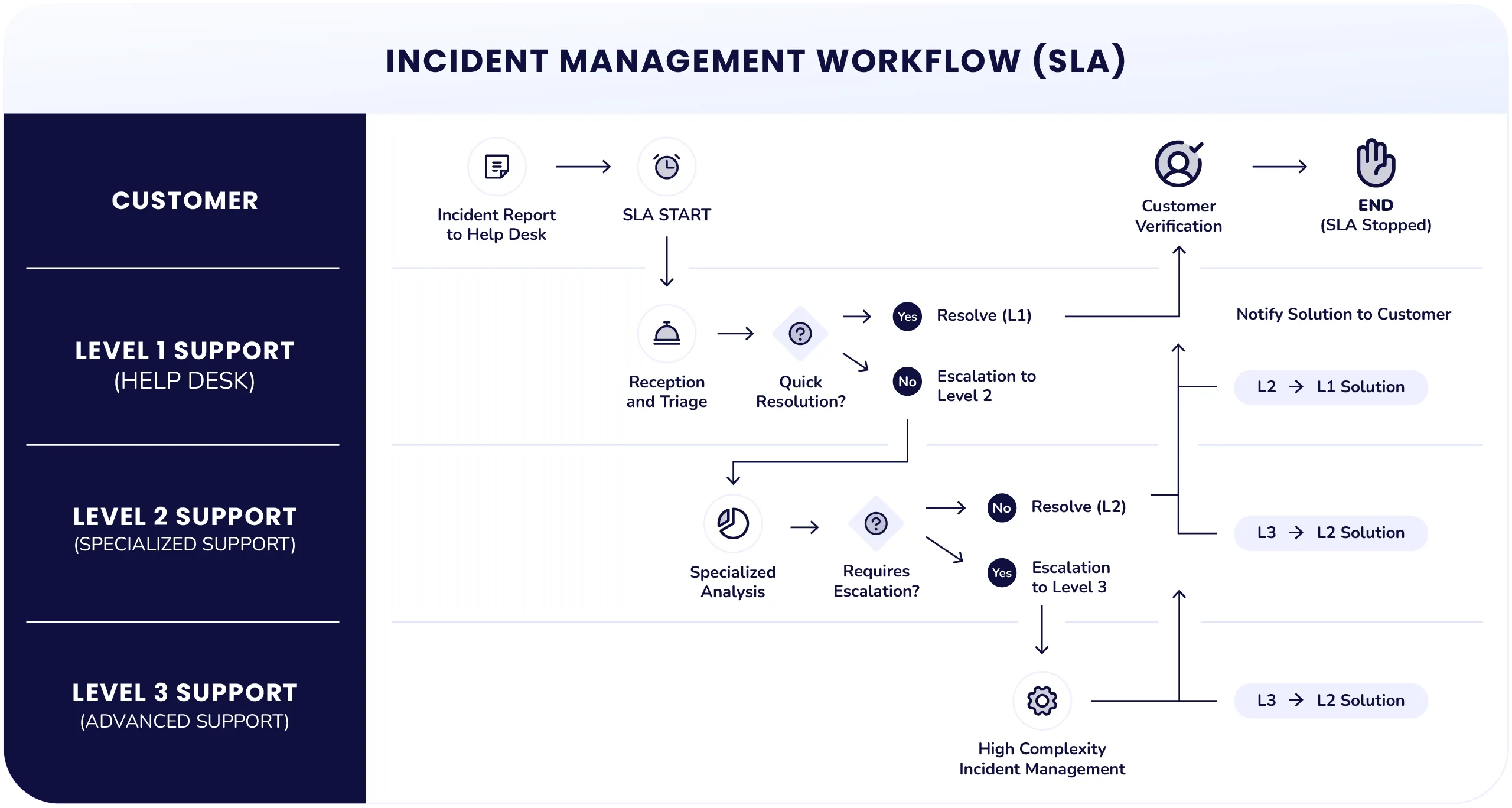
Service Levels – Tiered Support Model
SAGICC operates under a tiered support model in order to ensure efficient management of Incidents reported by the Customer.
- Level 1 – Help Desk: Serves as the single point of contact with the Customer. It is responsible for:
- Receiving, logging, and classifying Cases.
- Assigning the corresponding severity level.
- Providing initial support and resolving basic or recurring incidents.
- Coordinations of internal escalation when necessary.
- Communicating the status and closure of the Case to the Customer.
- Level 2 – Specialized Support: Handles Cases escalated from Level 1 that require specialized technical analysis.
- Level 3 - Advanced Support: Handles incidents that require intervention at the infrastructure, architecture, or product source code level.
Levels 2 and 3 operate internally and do not constitute direct communication channels with the Customer. All interaction will be conducted through the Help Desk (Level 1).
Application Form
The Ticket System can be accessed via the web or by making the request by:
- Email: soporte@sagicc.co, support@sagicc.co
- Phone: +57 605 3198908
- WhatsApp and Phone: +1 7865501652
- WhatsApp: +57 300 9110602
SAGICC will submit a support ticket for the service/maintenance report, identifying the severity. Reports will only be closed once the service is completed and with the prior agreement of the client.
7. Service Goals
a. Service Availability
The percentage of availability that SAGICC offers on THE PLATFORM is 99.96% per month, throughout a calendar month. The “Monthly Availability Percentage” in a particular application is the rate of time in which the application was available to THE CUSTOMER in relation to the total time counted in a month. Time is measured in 24-hour intervals and in monthly 30-day cycles. Availability is always calculated for a whole month. An interval is marked as unavailable if attempts to connect to the platform are rejected or unsuccessful.
Calculation of Availability Level
Formula: ND = (x / z)
Where:
- ND: It is the level of availability for the period.
- X: It is the number of effective hours available during the entire period. To calculate this number of hours, only those hours in which the service was not available for reasons attributable to SAGICC will be subtracted.
- Z: It is the number of hours in the period that the service should be available, i.e. twenty-four (24), multiplied by the number of days in the period in question.
Note: Planned maintenance activities, or emergency events, unavailability by the cloud provider (Amazon Web Services) or communication channels, will not be counted towards the unavailability period.
8. Exceptions to SLAs
This SLA shall not apply in the following cases:
- Third-Party Services: Interruptions, degradations, or failures arising from services provided by third parties integrated with or used by the Customer through the platform, including but not limited to messaging services, social networks, telephony, cloud providers, BYOC services, or any other external provider.
- Customer Infrastructure or Connectivity: Issues arising from the Customer’s own networks, devices, configurations, technological infrastructure, or connectivity.
- Customer Configurations or Actions: Incidents caused by configurations performed by the Customer, improper use of the Service, inadequate credential management, or failure to follow recommended best practices.
- Events Beyond SAGICC’s Reasonable Control: Including force majeure events, widespread internet failures, large-scale external attacks, acts of authority, or any circumstance not directly attributable to SAGICC.
- Unofficial Reporting Channels: The commitments established in this SLA shall apply only when the Incident is reported through the official Help Desk channels defined in this document. SAGICC does not guarantee response times or service levels when reports are submitted through unauthorized means.
9. Billing associated with SLA compliance
In the event that the expected availability percentage is not met, SAGICC will apply the following compensation formula:
THE CUSTOMER may request from SAGICC, within a maximum of 30 days after the invoice issuance date, compensation in the form of credits, which will be applied in the next billing cycle. The credits to be issued will correspond to 5% of the invoiced value of the affected service for each additional 1% of service unavailability beyond the expected level. In no case shall the credits issued exceed 50% of the invoiced amount.